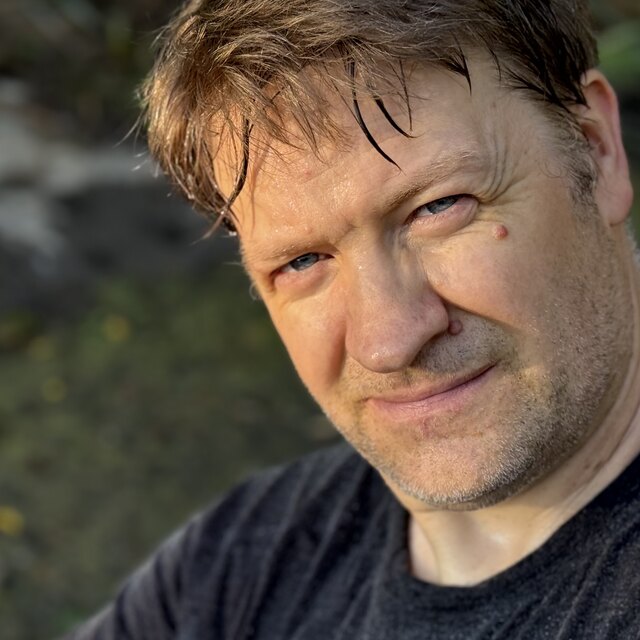
 Ithaca, NY
Joel Pennell
I'm a problem solver who works at the cutting edge, which right now means building software with AI as my collaborator. I co-founded TeamWeaver and I run DHU Labs, a one-person software lab. In under two years I've shipped about fifty working projects. Before that I raised my two kids at home for nineteen years, and before that I spent seven years shipping hardware and software where music, computers, and people meet.
The longer story
Music got here first. My dad was a postal carrier and lived an hour from his work, so his commute started early and mine did too, and on those drives the radio played synth pop, early reggae, and dancehall before he dropped me off at school. I bought my first record at eleven, learned to DJ on belt-drive turntables and then Technics, and by my teens I was playing parties.
What I always wanted to know was where this music came from and how it was made. Chasing that led me through synthesizers into computers. I was sequencing MIDI on an Atari before I ever heard of BeOS, and plenty of the music I love was made on early machines like that. What pulled me to BeOS was the engineering: a 64-bit file system, an architecture built for media from the ground up, and the way it made the same hardware feel far more powerful than Windows or the Mac OS of the day did. I built my own dual-processor computers to run it, because a BeBox cost more than a teenager had. I never got my hands on Final Scratch, the BeOS software that first let you DJ digital files from real turntables, though I did beta test Stanton's digital DJ system later, when it ran on Windows. I put what little money I'd saved into Be stock and lost all of it.
Work started at twelve, stacking stone pallets in the summers at my stepfather's quarry, the one that supplied the stone for Cornell's early buildings. At seventeen I put my board in my car and drove to Mount Hood, met people on my first day who took me in for the summer, and came home sponsored by Never Summer after their industry friends photographed me riding and sent the pictures in. The plan was to go professional. I taught snowboarding at my local resort, got certified, took an instructor job at a new resort in Park City, and an injury from the summer before got worse on the mountain until it sent me home for good. Home meant getting serious about a software degree at the local two-year college, where I learned something more useful than the degree: I love the high-level thinking about what software should be and do, and I have no love for writing it line by line.
My final-semester internship was at Glyph Technologies, a company I already knew because their storage powered the samplers I made music with, and I could hardly believe they were right here in Ithaca. They put me on a new venture called NetDrives, where I helped build, test, and ship the Brujo, one of the first standalone consumer MP3 players, a box that played MP3 CDs on your home stereo, and part of the job was explaining to people what an MP3 even was. I tested thin-client systems at Neoware through the dot-com years, moved home to Ithaca, and came back to Glyph as an engineer, on the four-person team behind the GPM-216, a peer-to-peer personal monitor mixer that ran audio over a network and split the work across modular nodes. We built the first hundred units and debuted it at AES in 2005.
When our first kid was born, one of us was going to be at home, and I took the job. For nineteen years that was my work, including homeschooling both kids until they were ready for regular school. It was more work than any job I've had, and all of it was work nobody assigns and nobody reviews, which is most of what working for yourself asks. I kept building through all of it: workstations, music production, and AI the moment it started to matter.
Then AI collapsed the distance between thinking of something and building it. I was pushing at that before the tools were any good, generating code in a chat window and pasting it into files by hand. I started with TeamWeaver, the company I co-founded to measure how teams actually collaborate, and I built all of its technology, both versions. Since then I've built about fifty working projects: a revenue-intelligence tool that turns a sales team's emailed updates into deal records, a personal medical AI that runs locally so health data never leaves the house, a security scanner, a field-coverage app for enterprise field officers, an audio platform aimed at an AI-native DAW. They cover that much ground because I would rather learn a new domain than repeat one I already know. Most of the fifty are private or built for someone else's business, some of it as paid client work, so you can't browse them all; the ones you can try are below, and I'm glad to talk through the rest. I work with several AI agents and they do the implementation, some of it on hardware I built here for running models locally. I do what I've always been better at: deciding what's worth building, holding the scope, and judging whether the thing actually works.
Most of the skill turned out to be in what surrounds the code. My working projects keep written notes on what is currently true, what was decided and why, and what the last session left unfinished, so an agent starting fresh in the morning picks up where the previous one stopped. And I don't take an agent's word that something works. It gets run against the real thing, and on anything that matters, a second agent that didn't write it reads it, told what to hunt for. On one project that second read found a real problem all three times it ran.
What I'm working on
TeamWeaver is the company I co-founded. It measures how teams actually collaborate, and its free tool, The Meeting Read, reads a Zoom, Teams or Google Meet transcript you paste and hands back an honest picture of how that meeting went, right in your browser, without your transcript ever leaving your machine.
DHU Labs is my software lab. Businesses bring me something slow, manual, or confusing, and I tell them honestly whether software would help, including when the answer is no. When it would, I build it while they watch it take shape.
HAP-OS is an operating system for humans and AI working as real pairs, using whatever computing you own, local or cloud. It's the most ambitious thing I've built, and it isn't public yet. It's where I think work is going.
What's live
The Meeting Read is free and needs no signup, so that one you can use right now.
Three others are running, but they are invite-only, so they take an email rather than a click. AgentProof scores how replaceable a business is by AI agents. AI Readiness scores a company's AI maturity in twenty questions. DHU Chat is a chat assistant that reasons from a written set of first principles instead of just generating agreeable answers; conversations with it have genuinely changed my mind on hard topics, and in side-by-side tests it consistently beats the same model running plain. Ask me and I will open any of them up for you.
What I've published
diagnose-defect is a free skill for Claude Code, MIT licensed. You give it the discussion where people described a bug, plus the code, and it works out the cause, proves it by running the code rather than by reasoning about it, and proposes a fix with a before-and-after test. It came out of real work and has since been run on a real problem in someone else's codebase. It's the first thing I've published this way, and the only thing it asks in return is to be told what it got wrong.
Get in touch
If you're building something, deciding whether to build something, or want to know whether I can help with a problem, email me. I answer.